Saint Aloysius Church
a place of worship in the Ironbound
About Us
Parish History
The story of St. Aloysius Parish in the Ironbound section of Newark is one of love and sacrifice of many generations of generous people. The parish was originally St. Thomas Mission attached to St. James, Newark. This church was located on Chapel Street and the Bowery (later called Fleming Avenue). On July 26, 1879 Rt. Rev. Michael Corrigan, the bishop of Newark, appointed the Rev. Walter M. A. Fleming rector of St. Aloysius Parish, which was in the northeast portion of St. James vineyard. The area of the new parish was very large, but was mostly marshy meadowland.
For a time, board was given to Father Fleming by St. Mary’s Orphanage on South Orange Avenue. A house to house visit found a great treasure of 1,487 persons for the new parish. Not a street was paved with stone, but the hard-working people with their generous-given mites finally raised one hundred thousand dollars for the new church. In the afternoon of June 20, 1880, Rt. Rev. Bishop Corrigan laid the cornerstone of St. Aloysius Church.
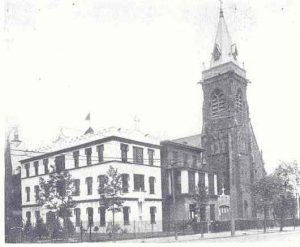
The edifice is Gothic in style, build of Newark and Belleville brown stone with an internal ceiling finish of oak panel. The cost was over $45,000. Among those present at the cornerstone ceremony were Father Walter Fleming, Father Hoban, Father O’Mahoney O.P. and Very Rev. William Walter O.S.B. Father Flynn preached at the great occasion. The dedication of St. Aloysius Church took place on May 8, 1881. Joseph P. Murphy and his brother, William, served as altar boys at the first Mass.
In 1882, Father Fleming built the rectory, and in 1884 the Sisters’ convent, both substantial stone structures in harmony with the
architectural features of the church. Father Fleming did not delay to make provisions for the children of the parish. In 1886, the pupils and teachers were comfortably housed in schools on Freeman and Oxford Streets. Chimes were installed in the church in 1888 at the cost of $5,000. Father Fleming assigned the young Michael Shine to play the chimes, after they were blessed by bishop Winard Wigger. For fifty years Michael Shine made the chimes ring out on Sundays and Holydays, calling thousands to worship. He served under many pastors, including Rev. M. McManus, Msgr. George Fitzpatick, Rev. John Preston and Rev. Charles Shaw.
Father Fleming’s premature death of pneumonia in January, 1892 was a great loss to all. His body was entombed in the basement of the Church, under Our Lady’s Altar. In 1916, the bowery was renamed Fleming Avenue in memory of the first pastor of St. Aloysius. Rev. M. A. McManus became the second pastor in 1892. He had a Club House erected for young men which opened in September, 1898.

Father McManus was often seen riding his horse throughout the parish while visiting his parishioners. He remained pastor until 1909. Rev. George Fitzpatrick was appointed pastor in 1909 and served the parishioners until 1914. Rev. John Preston became pastor in 1914. He had the size of the rectory increased by adding offices, as well as the rector’s study and sleeping quarters.
Many people of former years, knew our parish as “Ballantines” and rightly so, since we were surrounded by the buildings that
housed the great brewery of P. Ballantine & Sons. In the 1920’s, the parish purchased the red brick structure which had been Ballantine offices since 1902. This became the new schoolhouse. The brewery supplied heat to all the buildings. In exchange for the heat, church property was used by Ballantines for parking lots.
This history would not be complete without recognizing the zeal and dedication of the parish’s many assistant priests, Sisters and lay teachers of the past and present. God alone knows the tremendous good they’ve accomplished while serving the “Downeck” people of St. Aloysius Parish. Countless others have given of their time and energy to aid the parish throughout these many years. Their concern and loyalty will long be remembered. The warmth and love of the people of St. Aloysius have captured many hearts during these many years.
May God shower His blessings on all the living, and His peace on those departed, from St. Aloysius Parish in Newark.
Patron Saint

During the plague that hit Rome in 1591, St. Aloysius volunteered at a hospital for the sick. During his dedication to the sick, he became infected with the plague and suffered with it for months until his early death on June 21, 1591. He was 23 years old. One year prior it was said that he had a vision in which an angel told him he would die within a year.
He was beatified fourteen years after his death by Pope Paul V, on October 19, 1605. On December 31, 1726, he was canonized by Pope Benedict XIII. His legacy lives on and was named patron of all Christian youth by Pope Pius XI.

Saint Aloysius de Gonzaga was born in March 9, 1568 in Castiglione delle Stiviere in the Holy Roman Empire. Born into the illustrious House of Gonzaga of Northern Italy, he was the first of seven children of Ferrante de Gonzaga, Marquis of Castiglione, and Marta Tana de Santena.
The son of a Marquis and part of a wealthy and influential family, he received a lot of military training so as to inherit his father’s title one day. As a child growing up in the turbulent Renaissance era in Italy, he witnessed a lot of violence and brutality which created a lot of empathy in his heart towards humanity. At age 8, he was sent along with his brother to serve at the court of the Grand Duke Francesco I de’ Medici. While there, he became ill, an illness that would leave him in a fragile state for the rest of his life. He spent most of his recovery time reading about the saints and spending a lot of time in prayer. After reading a book about Jesuit
missionaries in India, Aloysius felt a calling to become a missionary and started teaching catechism classes to young boys. He was deeply touched by the violence he witnessed as a child growing up in the turbulent Renaissance era and desired nothing more than to dedicate himself to godly services, rather than falling into the temptations of the world that he saw all being inspired by the devil.
At the age of 11 he and his brother were called to serve the young Infante Diego in Spain. Although it went against his own plans, out of obedience to his family and loyalty to the Emperor, Aloysius cared for the prince with lots of dedication. This is where he decided he would relinquish his first-born right to his brother and began thinking about joining a religious order. He began his theology studies against his father’s wishes and took three religious vows of chastity, poverty and obedience.His battle with his father continued well after they left Spain and returned to Italy, Aloysius was then 16. After years of trying to convince Aloysius into another type of life, his father finally gave his blessings. The Emperor transferred rights of succession to Aloysius’ brother and at age 18, Aloysius left to Rome and entered a Jesuit house.